
Marisera Journal · Mechanism explanation
Why finishing the day and winding down can feel like two different jobs
By Marisera | October 4, 2026 | Sponsored editorial
A completed evening routine can be surprisingly unconvincing.
The messages are answered. The room is ready. Tomorrow's essentials have been prepared. On paper, the day is over.
But attention is still in a meeting that has not happened, a decision that has not been made, or a conversation that cannot be controlled from bed.
At that point, a product promising “relaxation” may seem appealing. It may also seem suspiciously unspecific. Does it explain anything about the situation? Does it offer a different experience, or just put a new word on another item to buy?
Understanding the difference begins by separating the practical end of the day from the experience of winding down.
Preparation solves the jobs that can be prepared
Putting the phone away changes where the phone is. Packing a bag changes what needs doing in the morning.
Those are useful actions with defined outcomes. They cannot determine how tomorrow's conversation will go, or make every responsibility feel closed.
That is why “try a better routine” can miss the reader's actual situation. There may already be a reasonable routine. Its remaining challenge is the transition out of planning, rather than a missing room-setting trick.
Any additional care product should have a role that makes sense in that transition. It should not make every existing habit sound like a failure simply to create room for itself.
The Stress–Magnesium Loop offers context, not a personal diagnosis
A 2020 scientific review discusses possible interaction between stress and magnesium status. That is the educational basis for the Stress–Magnesium Loop.
The useful distinction is between a relationship worth understanding and a conclusion about one person's evening. The first can inform a discussion. The second would require evidence that a bedroom scene does not supply.
The relationship makes magnesium worth understanding. Busy thoughts alone cannot establish deficiency, and this research does not show that applying a cream replenishes magnesium through the skin.
With that boundary clear, the next question can be about the product itself.
A formula needs an explanation beyond “contains magnesium”
Consider three different things a buyer might want to understand: the mineral ingredient, the surrounding formula and the application format.
An ingredient name answers only the first. A clear body-care proposition should answer all three.
Is this a swallowed nutritional product or something for massage? Is aroma part of the intended experience? Does it contain ingredients the buyer specifically wants to include—or leave out—at bedtime?
These questions are often more useful than assuming that a longer ingredient list means a greater effect.
The Marisera Layered Wind-Down Ritual makes those choices concrete
Marisera Night Cream combines a magnesium chloride foundation with its botanical formula and a shea-and-cocoa-butter base intended for hands-on body care.
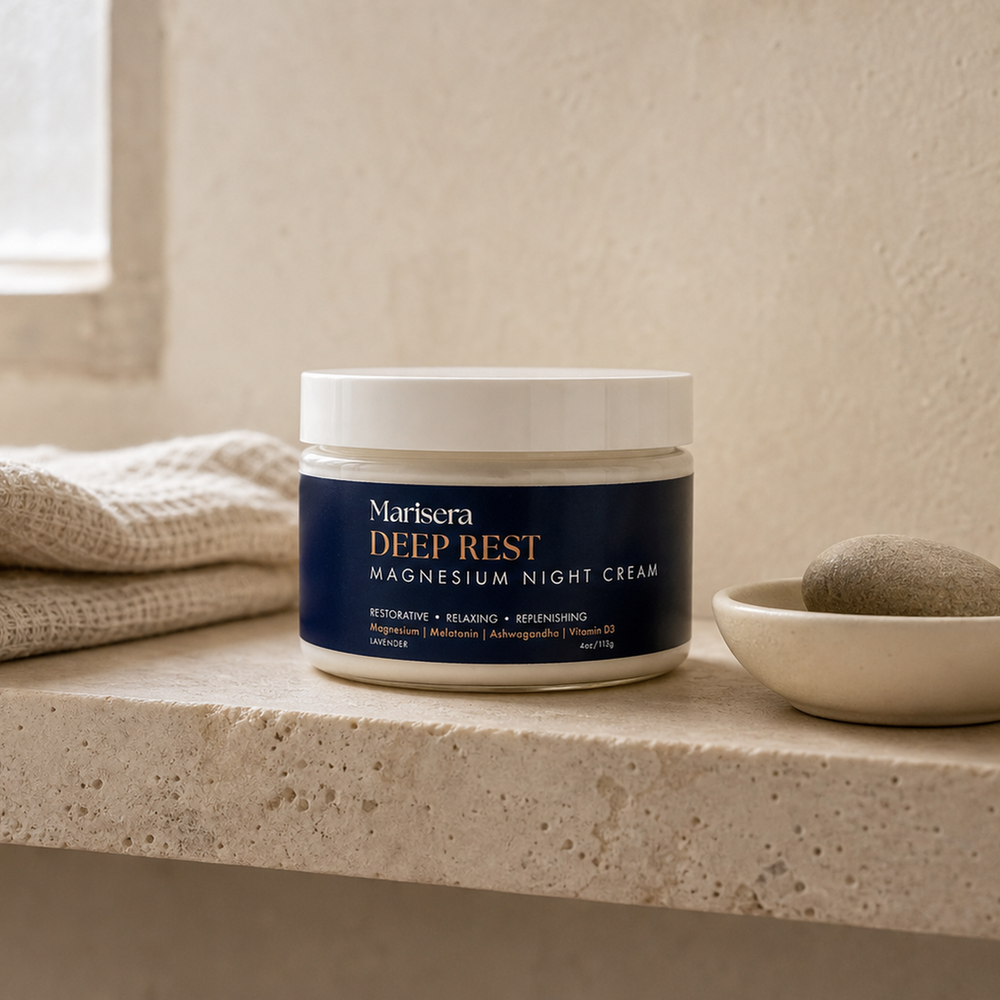
That creates a specific application occasion after the necessary jobs are complete: applying a cream and taking time for massage, rather than preparing a drink or swallowing another product.
The choice continues at formula level. Deep Rest includes lavender and melatonin. Deep Calm is fragrance-free and melatonin-free. The distinction lets the buyer choose the intended sensory and ingredient experience instead of treating all bedtime creams as one category.
The difference is practical: choose the ingredients you want, in a format intended for massage, for the moment after the practical preparation is complete.
How to read the proof without asking it the wrong question
The research reference explains why magnesium belongs in the discussion. The formula information explains what is offered in the jar.
Neither should be silently turned into a finished-product sleep trial. Equally, the presence of a research limit does not make ingredient selection or a preferred massage format meaningless.
A buyer can value understandable ingredients, a deliberate care occasion and a chosen formula without needing to believe a guarantee about tomorrow morning.
If the central objection is “Will this become another chore?”, begin with the actual directions. If the objection is “Which formula fits?”, compare Deep Rest and Deep Calm. If it is “Does it replace my supplement?”, keep nutrition and topical body care separate.
The product idea in everyday language
Illustrative testimonials — fictional examples, not actual customer reviews.
“What drew me in was the magnesium. What made the choice concrete was being able to compare Deep Rest with Deep Calm instead of treating every evening cream as identical.”
“I do not need another bedtime scorecard. I want a hands-on care moment with a clear beginning and end.”
Choose the part of the evening that can be chosen
Tomorrow's tasks will still have their own place. The evening care experience can have one too.
See the Night Cream ingredients, formula options, directions and current price on the product page. Decide whether the Layered Wind-Down Ritual fits the transition after the checklist is finished.